
Did you know that importing goods from high-carbon sectors into the European Union without being able to justify their real emissions will directly impact your profitability?
With the implementation of the Carbon Border Adjustment Mechanism (CBAM, or MACF in French), transparency regarding the embedded emissions of products has become mandatory. It is no longer a matter of global estimates, but of precisely measuring the carbon impact of manufacturing every single ton of imported raw material.
Where does this law come from? Understanding the European Carbon Market (EU ETS)
To understand CBAM, you must first understand what has been required of European factories since 2005: the EU ETS (European Union Emissions Trading System) or SEQE (Systeme d’Echange de Quotas d’Emission) in French.
- The “Polluter Pays” Principle: The EU sets an overall cap on CO2e emissions for heavy industries (steel, cement, chemicals, etc.). Large, energy-intensive industrial sites (power plants, steelworks, cement plants with over 20 MW of power) that emit CO2e must purchase carbon allowances (1 allowance = 1 ton of CO2e) on an official financial market. The average price of this ton generally oscillates between 65 EUR and 85 EUR.
- The Unfair Competition Trap (or “Carbon Leakage”): If EU factories pay this tax while foreign factories outside the EU pay nothing, two risks emerge:
- EU companies relocate their factories outside the EU to avoid paying.
- Buyers abandon EU producers to import cheaper, but potentially highly polluting, raw materials.
Why Create the CBAM Today?
To prevent these shifts, the EU previously granted free allowances to local industrial players. The EU has decided to phase out these free allowances while applying the exact same financial rule to imports. CBAM is simply the EU’s carbon customs tariff.
.
Scope of the CBAM
Who Is Affected?
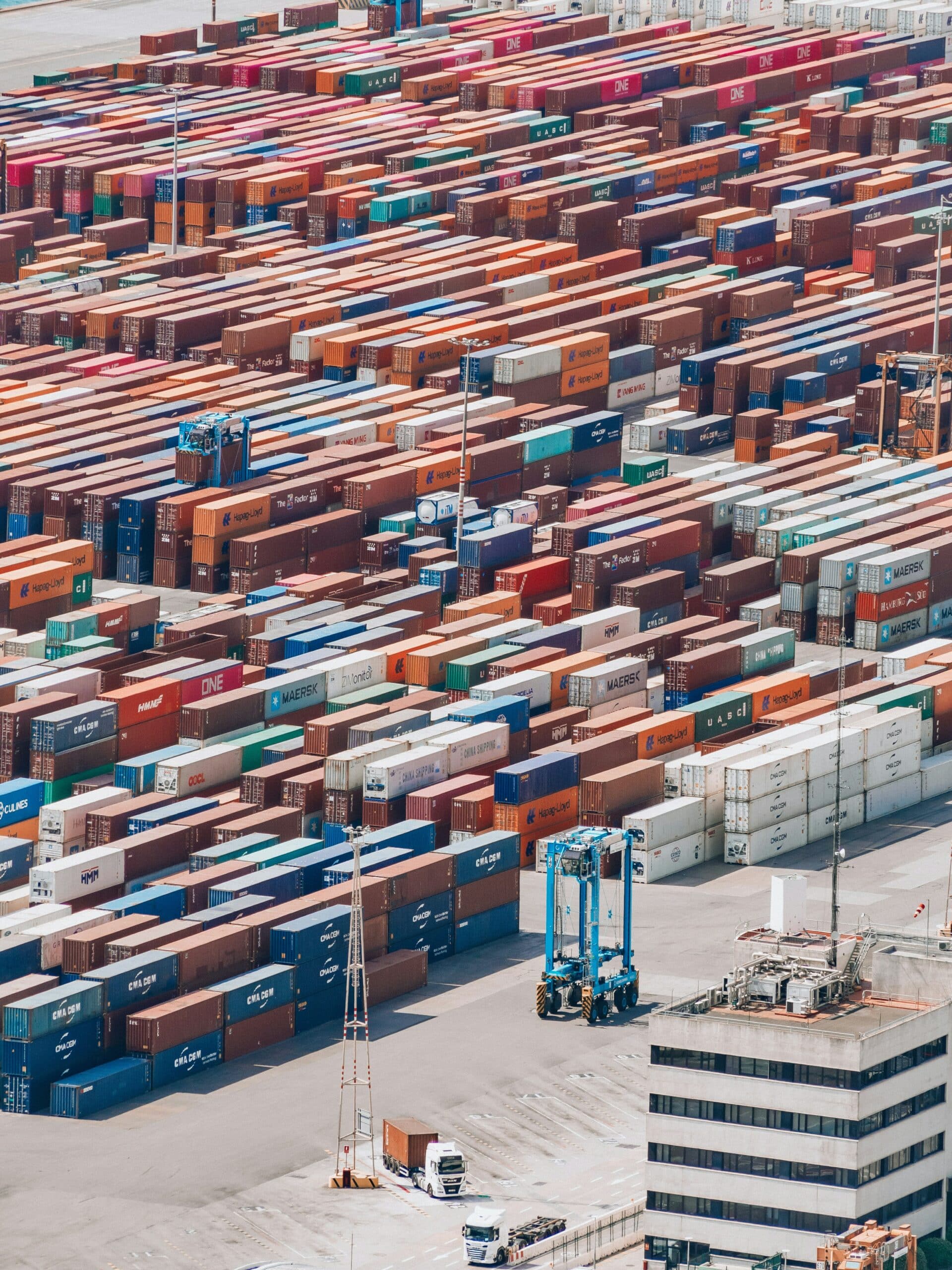
CBAM does not apply to all goods, but targets the most carbon-intensive industrial sectors. It applies to companies established in the European Union that import goods produced outside the EU.
Currently, 5 sectors are subject to CBAM:
- Iron & Steel
- Aluminum
- Cement
- Fertilizers
- Electricity & Hydrogen
Note: If you import products whose CN code is listed in Annex I of the CBAM Regulation, you are affected by CBAM, except for importers importing less than 50 tons of CBAM goods per year (excluding importers of electricity and hydrogen).
What Is an “Embedded Emission”?
It is the total amount of CO2e released to manufacture the product, calculated from “cradle to gate”. This includes direct emissions (combustion in factory furnaces) and indirect emissions (electricity consumed to manufacture the product).
Warning: A classic corporate Bilan Carbone (Scopes 1, 2, and 3) measures the overall activity of a company over a year, but it is unusable for CBAM. The regulation requires a specific, traceable calculation per product or raw material category. Indeed, EU regulations prohibit the use of monetary averages or global corporate carbon footprints. For CBAM, the calculation must be tied to the precise 8-digit customs code of the imported good and scaled to a physical unit (for example, tons of CO2e per ton of steel or aluminum). The evaluation requires traceability for every single production line. Each data point entered must be backed by auditable evidence (energy bills, meter readings, technical sheets, etc.), making the LCA methodology essential for submitting a compliant file to verifiers.
Calendar:
The implementation of CBAM was rolled out progressively according to the following schedule:
- October 1, 2023 – December 31, 2025 (Transition Period): The learning phase. Importers had to submit quarterly emissions declarations (with no financial impact) no later than 30 days after the end of each quarter.
- January 1, 2026 (Definitive and Paid Phase): Financial obligation takes effect. Only authorized CBAM declarants (having applied for the status) are permitted to import targeted goods.
- May 31 Each Year (Starting in 2027): Annual deadline for official declarations. Importers must declare in the European registry (the central official digital platform established by the European Commission) the volumes imported during the previous year (ex: by May 31, 2027, for the year 2026) and surrender the corresponding number of CBAM certificates (carbon allowances).
The Financial Formula: How much will you have to pay?
Each year, the importer must purchase and surrender CBAM certificates. Their price is adjusted weekly based on the average price of the EU carbon market (ETS).
Importers can calculate the cost CBAM will represent using the following formula:
CBAM Cost (EUR) = [ SUM (Mi x SEEi) – Kfree ] x Pcertificate – Cthird_country
Where:
- Mi (Mass of goods): Total quantity of imported products of type i (expressed in tons).
- SEEi (Specific Embedded Emissions): Carbon intensity of the good (expressed in tCO2e per ton of product). These are either the declared real emissions or default values set by the EU.
- Kfree (Free allocation adjustment): Volume of emissions deducted to account for free allowances still granted to EU manufacturers (progressive reduction between 2026 and 2034).
- Pcertificate (CBAM certificate price): Unit price of a carbon certificate in euros, equal to the weekly average price of EU ETS allowances.
- Cthird_country (Carbon deduction at origin): Amount of the carbon price already effectively paid in the country of origin for the production of the good (in euros), subject to supporting documentation.
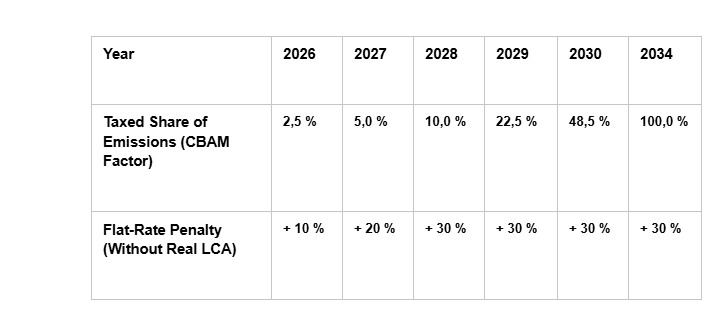
Note: The EU does not apply 100% of the tax right away, but increases the coefficient — officially called the CBAM Factor — year by year. This factor is simply the progressive application rate of the carbon tax:
What Is the Financial Impact of an LCA?
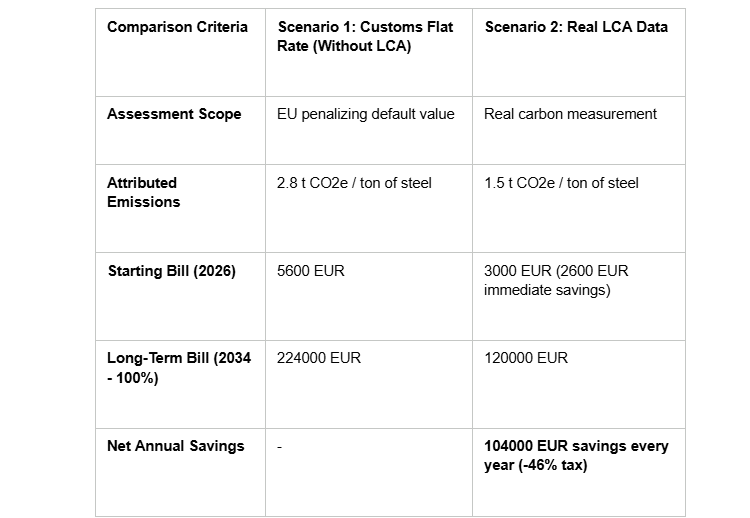
Importers pay two to three times more for their carbon certificates without a real LCA:
- With a real LCA: Certificates are paid only on the exact amount of CO2e emitted by the plant (ex: 1.2 tCO2e per ton of steel).
- Without a real LCA (penalty flat rate): Certificates are paid on the EU’s penalizing default value (ex: 2.5 tCO2e per ton of steel + a flat-rate surcharge of 10% to 30%).

Life Cycle Assessment (LCA): Your Only Shield Against Surtaxes
If you cannot scientifically prove the real carbon footprint of your imported product, customs authorities will apply penalizing default values (based on the most polluting factories in the world).
To avoid this extra cost, the only scientific method recognized by the European Union is the Product Life Cycle Assessment (LCA / ISO 14067 standard).
Example: The Direct Economic Impact of an LCA
Imagine importing 1000 tons of raw steel from outside the EU (with an estimated carbon price of 80 EUR/t):
Why Entrust Your LCAs to a Specialized Firm?
Obtaining carbon data from a factory located on the other side of the world cannot be done through a simple email questionnaire. The European text imposes strict methodological rigor (ISO 14067).
Hiring a firm to conduct LCAs on your products or those of your suppliers guarantees 4 major strategic benefits:
- Complex Data Collection from Foreign Suppliers: Engaging directly with your international partner factories to collect high-quality, reliable data efficiently.
- Guaranteed Compliance for Regulatory Audits: CBAM declarations must be verified by accredited third-party verifiers. Highly precise LCA files ensure first-time validation by auditors.
- Immediate Profitability: The financial investment required to perform an LCA is quickly amortized through significant savings on certificate purchases.
- Operational Peace of Mind: Avoid heavy penalties, suspension of your authorized declarant status, and customs delays at the border.
Take Action!
CBAM is not just an administrative burden: it transforms your procurement costs and presents a strategic opportunity for companies working with low-carbon products. By rigorously demonstrating the low-carbon impact of your supply chain through LCA, you secure financial savings and gain a competitive edge.
As experts in carbon accounting, we perform Product Life Cycle Assessments (LCAs) for your purchases and products and secure your declarations.
Planning an LCA project? Fill out the form below to speak with our experts and identify your profitability levers.